
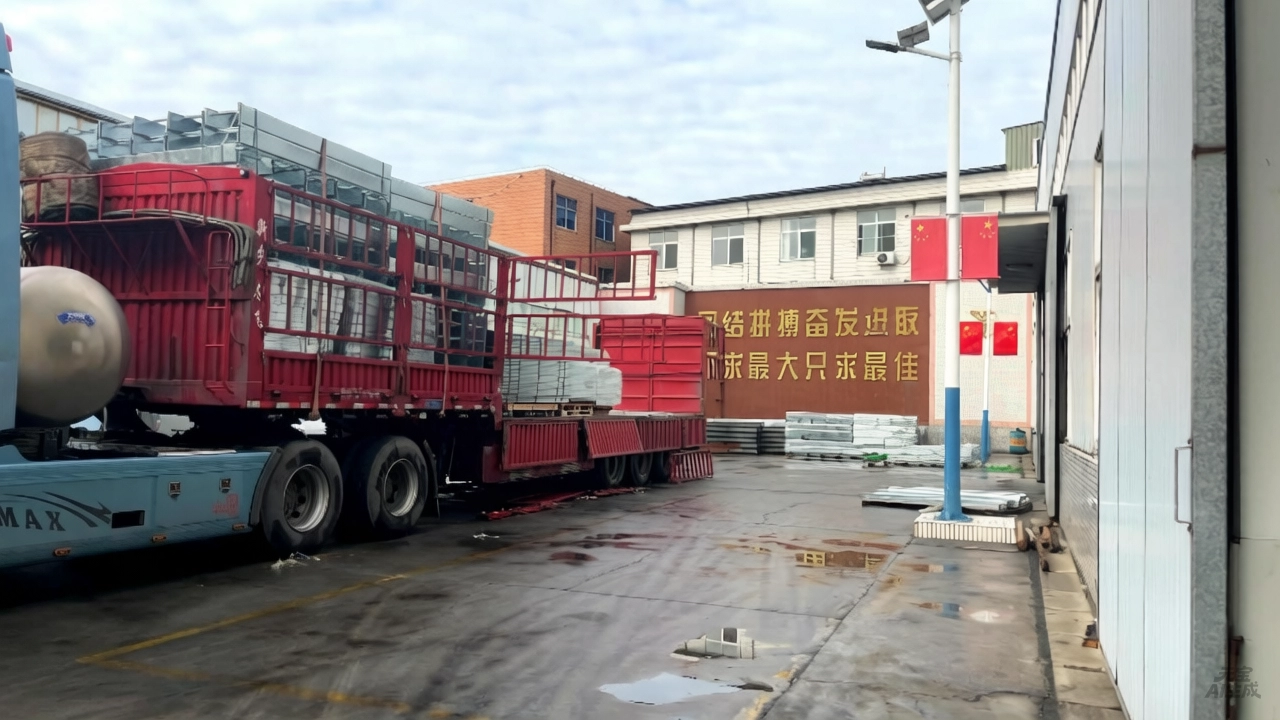
Most enquiries begin with the same sentence: we need the cable tray customized. The useful follow-up question is customized where - because a tray run is a system of sections, fittings and accessories, and some of those elements can be changed freely while others are fixed by the load data and certification behind them. This guide separates the flexible part from the fixed part, so the brief you send is one a factory can quote without guesswork.
1. Dimensions: Width, Height and Material Thickness
Width, side height and material thickness are the most commonly customized attributes, and they are also the three that interact with load capacity. A wider tray carries more cable but needs a deeper section or heavier gauge to hold the same support span, and a heavier gauge increases both weight and cost for the whole run. If the widths and thicknesses in your drawing were chosen against a load-deflection table, say so when you send the enquiry - it tells the factory that the dimensions are load-driven rather than an arbitrary choice. How load, span and thickness relate to each other is covered in how to specify a cable tray system.
2. Perforation, Rung Spacing and Ventilation
On perforated tray-type trays the hole pattern does three jobs at once: it lets heat out, lets water drain, and provides tie-down points for cable ties. Hole size, pitch and the proportion of open area can all be adjusted within the strength limits of the section. On ladder trays the equivalent variable is rung spacing - closer rungs support smaller cables and heavier loads, wider spacing reduces weight and cost. Both are customization that carries no tooling penalty if the pattern is already in the standard range.
3. Finish and Coating Specification
The finish is where customization has the largest effect on service life. Hot-dip galvanising forms a metallurgical bond across all surfaces including cut edges, typically at 65 to 85 microns, and remains the standard for outdoor and humid industrial work. Zinc-aluminium-magnesium coatings are specified where a longer service life is wanted in aggressive environments. Powder coating adds a colour and gloss specification on top of corrosion protection, stainless steel in 304 or 316 is used for food, pharmaceutical and chemical installations, and aluminium alloy keeps weight down on long runs. Polymer and polyurethane options exist for specific chemical exposures. Whatever is chosen, confirm that the coating specification is written into the order rather than implied by a sample. A side-by-side comparison of the main finishes is in cable tray materials compared.
4. Fittings, Bends and Non-Standard Geometry
A tray run is rarely straight. Bends, tees, reducers, risers and transitions are fabricated to match the section, and this is where custom geometry usually appears: a radius that has to clear a structural beam, a transition between two different tray widths, or a fitting that has to interface with equipment that was not designed for a standard tray. These items should be listed as a fitting schedule with a drawing reference, because a missing fitting stops the installation even when every straight section is correct.
5. Accessories, Branding and Packaging
The accessory set is part of the customization, not an afterthought. Connecting plates and screws, threaded rods and hanging frames, and bonding jumpers for electrical continuity all need to match the tray section and the support arrangement. Packaging is customizable as well: neutral or custom logo packaging is available, and label content, bundle sizes and carton or pallet arrangement can be set to suit the site or the distributor. The standard support and continuity items are listed under auxiliary materials.
6. What Cannot Be Customized, and Why
- Load data for a section you have changed: published load and deflection figures belong to a specific profile and thickness. Alter the section and the data no longer applies to the new item.
- Certification scope: ISO, CE and RoHS documentation relates to the products and processes covered by the audit, so a new process or material needs to be confirmed against that scope.
- Perforation that weakens the section: open area can be increased, but not past the point where the section no longer carries the specified load.
- Coating thickness on a complex geometry: a coating specification that cannot be achieved uniformly across a tight bend is not a specification, it is a hope.
- Standard test evidence for a one-off item: a custom fitting can be made to drawing, but it does not inherit the test history of the standard part it replaces.
7. What to Fix Before You Brief a Supplier
- Freeze the dimensions that are load-driven and mark the ones that are flexible.
- State the environment - indoor, outdoor, coastal, chemical or food-grade - because it decides the finish.
- Send the full fitting schedule, not only the straight sections.
- List the accessory set and the support arrangement.
- Confirm whether packing is neutral or carries your logo.
- Ask which items need a sample and which can go straight to production.
Tianjin Chuangshi Metal Products manufactures cable trays in hot-dip galvanised, zinc-aluminium-magnesium, powder-coated, aluminium alloy and stainless steel finishes, with custom widths, heights, thicknesses, fittings and packaging. Contact us with your drawings and quantities for a quotation.