
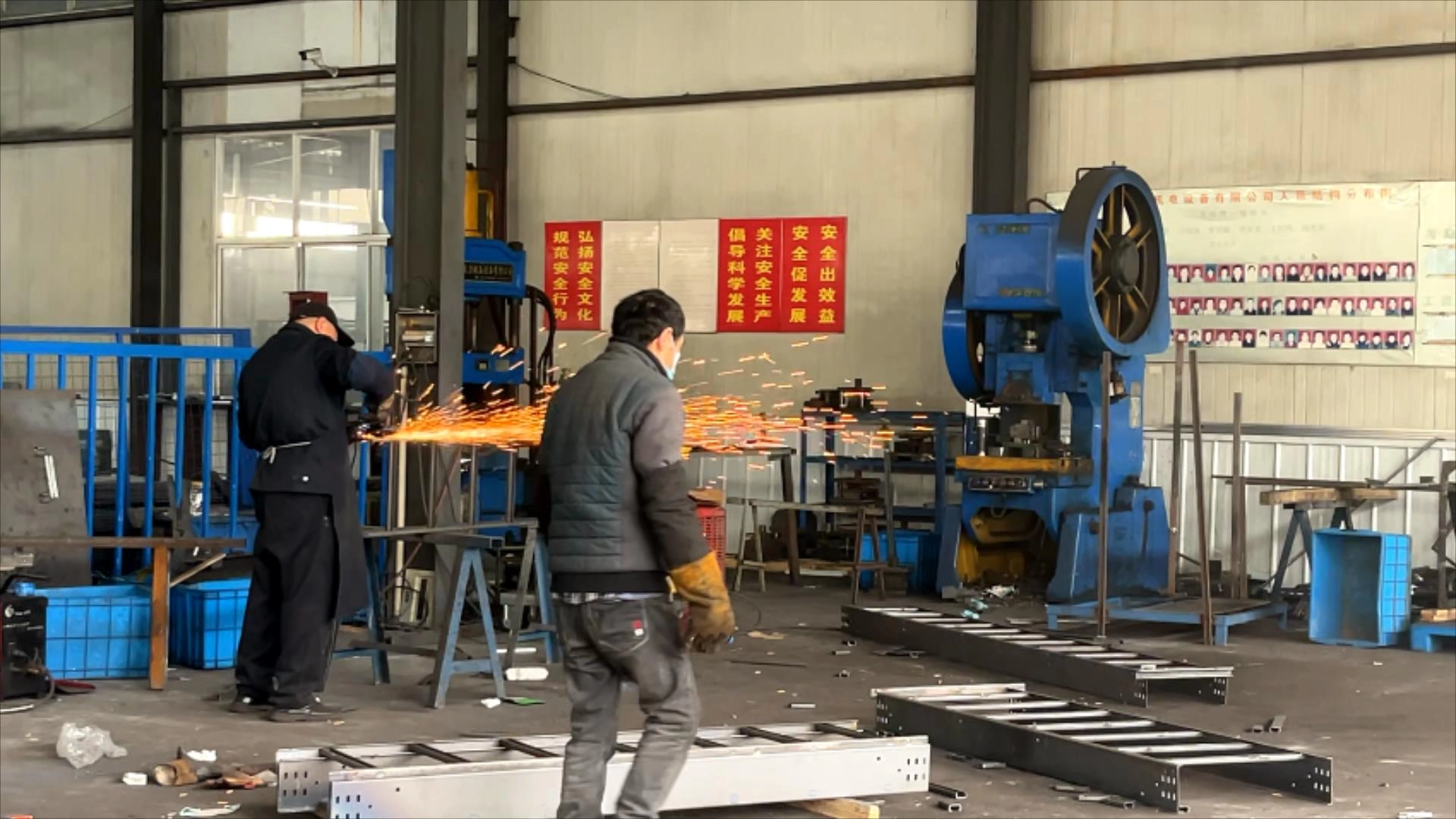
A custom cable tray order moves through a predictable sequence of steps, and most of the delays that buyers experience come from one of them being skipped rather than from production itself. This guide walks through a custom or OEM/ODM project from the first enquiry to the loaded container, and lists what to send at each stage so the project does not come back for information it should already have.
1. Step 1 - Send the Brief
The enquiry is the point where project cost and lead time are set, because everything downstream is measured against it. Send drawings or samples together with the information the factory needs to quote: materials and finish, quantities, the installation environment, and any certification requirement. If the project has a fixed delivery window or a nominated port, say so at this stage, since EXW, FOB, CIF and DDP terms change both the price and the shipping plan. The engineering inputs that matter most are the same ones covered in how to specify a cable tray system.
2. Step 2 - Drawing Review and Confirmation
An engineering review comes before any production commitment. It is where the section is checked for formability, where the coating process is confirmed for the finished geometry, and where questions about support spans, load expectations and accessories are raised. Expect the drawing to come back with queries if something in it is ambiguous; that exchange is normal and it is cheaper than discovering the problem after production. Production should not be scheduled until the drawing is approved in writing.
3. Step 3 - Sampling
Samples are available for custom work and typically take 3 to 7 days, with the upper end of that range belonging to the more complex items. A sample confirms the section dimensions, the perforation or rung pattern, the fit of the fittings and the finish, and for a first-time purchase it is the cheapest form of quality assurance available. Approve the sample in writing, and reference it in the order so that the sample and the production run are judged against the same definition.
4. Step 4 - Order Confirmation and Scheduling
With the drawing and the sample approved, the order can be scheduled. Two things are worth fixing at this point: the sequence of the finishing operation, because hot-dip galvanising and powder coating are separate process steps with their own batching, and the accessories, because connecting plates, hanging frames and bonding jumpers are produced alongside the trays rather than sourced afterwards. A complete release - trays, fittings and accessories together - avoids the situation where the installation is waiting on a small consignment of plates.
5. Step 5 - Production and Inspection
Production runs under the company's ISO9001 quality management system, with inspection covering the formed section, the fitting dimensions, the coating thickness and the finish appearance. Material test reports are available and should be asked for at order stage if your project requires them, so the documentation is prepared with the shipment rather than chased after it.
6. Step 6 - Documentation and Certification
ISO, CE and RoHS certification can be provided on request, and a typical export consignment also carries a packing list and the commercial documents required by the destination market. It is worth checking the documentation requirement early: a project destined for the Middle East, Southeast Asia or Russia may need the paperwork set out in a particular form, and the exporter should know before the containers are booked. The standard questions on samples, terms and markets are answered on our FAQ page.
7. Step 7 - Packing, Labelling and Loading
Packing is specified rather than assumed. Neutral packaging and custom logo packaging are both available, and bundle sizes, labels and pallet or carton arrangement can be set to suit a distributor warehouse or a site delivery. Long sections are bundled to survive road transport without distortion, and the loaded volume is checked against the quotation, since trays are a low-density product and a poorly nested load can waste a significant part of a container.
8. Step 8 - Shipping and After Delivery
Shipment is arranged on the agreed Incoterm from the main loading ports of Tianjin and Qingdao, which sit within reach of the Beijing-Tianjin-Hebei production base. After delivery, keep the approved drawing and the approved sample together in the project file - on a repeat order they are the fastest way to get an identical product without going through sampling again.
9. Sourcing Checklist
- Send drawings or samples with materials, quantities, finish and environment.
- Confirm Incoterm, destination and port before asking for the final price.
- Get the drawing approved in writing before production is scheduled.
- Ask for samples on complex or first-time items - typically 3 to 7 days.
- Confirm the accessory set and the fitting schedule with the tray order.
- State the certification and documentation requirement at order stage.
- Specify packing and labelling rather than accepting a default.
- File the approved drawing and sample for future repeat orders.
Tianjin Chuangshi Metal Products supplies complete cable tray systems - trays, fittings, supports and accessories - in hot-dip galvanised, zinc-aluminium-magnesium, powder-coated, aluminium alloy and stainless steel finishes, with OEM/ODM service and export documentation. See how the factory is set up, or contact us with your drawings and quantities to start a project.